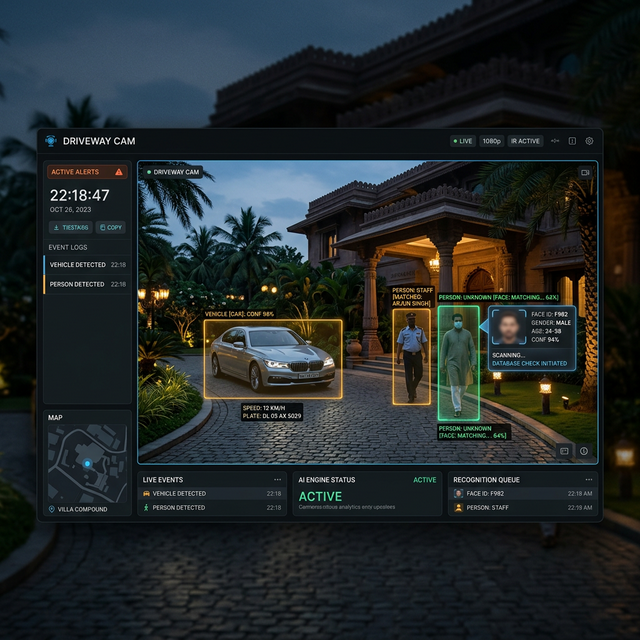
Traditional CCTV cameras on Bengaluru residential and commercial properties have historically operated as passive recorders: they capture video streams to a hard drive, leaving security personnel or homeowners to manually search through hours of footage after an incident occurs.
Modern IP camera technology incorporates deep learning analytics directly onto device chipsets. Rather than simply detecting raw pixel changes, edge analytics classify moving objects, evaluate perimeter boundaries in real time, and trigger timely alerts. At Synchronos Living, our engineers design surveillance networks with optical planning, network storage sizing, and isolated network routing. If you are evaluating security for your property, explore our professional CCTV installation and surveillance systems in Bengaluru.
How edge analytics differ from conventional motion detection
Traditional camera motion detection works by measuring pixel changes between video frames. Consequently, windblown trees, moving shadows, heavy rain, headlights, and insects routinely trigger nuisance motion alerts, causing alert fatigue.
AI-enabled IP cameras run neural network models on local processors (edge processing) to analyze visual geometry before sending notifications. The system evaluates whether an object matches defined physical parameters:
- Human target classification: Identifies human silhouettes and bipedal movement patterns.
- Vehicle target classification: Distinguishes between passenger cars, commercial delivery vans, and two-wheelers.
- Environmental filtering: Ignores non-critical motion such as rain, swaying branches, and small animals, significantly reducing nuisance notifications compared to pixel-based triggers.
Key video analytics capabilities for residential estates and commercial sites
1. Perimeter virtual line crossing and intrusion detection
Administrators can configure virtual boundary lines across camera feeds (such as along a villa boundary wall or commercial perimeter gate). When an object classified as a human or vehicle crosses that line in a designated direction during armed hours, the system initiates pre-programmed actions:
- Sends an immediate push notification with an attached video snapshot to the owner's mobile device
- Activates exterior security floodlights or strobe lights to illuminate the perimeter
- Triggers a localized pre-recorded audio warning via camera speakers
2. Automatic Number Plate Recognition (ANPR)
ANPR cameras utilize high-shutter-speed optical sensors and optical character recognition (OCR) algorithms to capture vehicle registration plates during day and night conditions:
- Authorized access lists: Automates motorized barrier gates when whitelisted family or company vehicles approach entry portals.
- Time-stamped audit logs: Records entry and exit timestamps alongside vehicle plate images for facility management.
- Visitor tracking: Replaces manual register entries at gatehouses, assisting on-site security guards with verified digital logs.
3. Facial recognition and access correlation
High-resolution IP cameras compare detected faces against on-premise reference libraries:
- Authorized arrival notifications: Alerts residents when family members or scheduled domestic staff arrive.
- Access control integration: Interfaces with electronic gates, biometric turnstiles, and video door phone systems.
- Restricted area monitoring: Identifies unauthorized personnel approaching private offices, equipment rooms, or server racks.
4. Loitering detection
Triggers an alert when a person remains stationary within a critical zone (such as outside a perimeter gate or alongside a parked vehicle) for longer than a specified duration, such as 45 seconds. This alerts security staff to potential surveillance behavior before an entry attempt occurs.
5. Supplemental video smoke and flame analytics
Specialized thermal and optical cameras detect smoke plumes and flame signatures across large visual fields. While these video analytics provide valuable early situational alerts for outdoor courtyards, open warehouses, and parking structures, they serve as supplemental indicators and do not replace statutory, certified aspirating fire alarm systems.
Hardware infrastructure: cameras, switches, and NVRs
A reliable surveillance network requires matched hardware across every layer:
- Optical low-light performance: Cameras equipped with large image sensors and wide dynamic range (such as HikVision ColorVu or Dahua Full-Color arrays) maintain color clarity in low ambient lighting without washing out faces under harsh infrared glare.
- Power over Ethernet (PoE) switches: Managed network switches deliver stable power and high data throughput to cameras over structured Cat6 cabling, separating camera data from general office or residential Wi-Fi networks.
- Network Video Recorders (NVR) with RAID storage: Centralized NVR units manage video streams, run secondary analytics, and store continuous footage across surveillance-grade hard drives arranged in RAID arrays to guard against single-drive hardware failures.
Privacy considerations and data management
Deploying intelligent video surveillance requires thoughtful data stewardship under India's evolving digital privacy landscape, including principles outlined in the Digital Personal Data Protection Act, 2023:
- Prominent notice: Display clear signage at entry gates and common property boundaries informing visitors that video surveillance is active.
- Appropriate data retention schedules: Establish storage overwrite schedules aligned with legitimate security needs and organizational retention policies, rather than archiving footage indefinitely.
- Access controls and network segmentation: Restrict video recorder access to designated security administrators and isolate surveillance traffic on a dedicated virtual local area network (VLAN) to minimize data exposure risks.
Planning an IP surveillance network for a residential estate or commercial facility in Bengaluru? Consult our engineering team on CCTV and perimeter security to review site layout drawings and camera coverage plans.
Frequently asked questions
Can AI surveillance cameras function without an active internet connection?
Yes. Primary video processing, object classification, line-crossing detection, and local video recording execute on the physical cameras and on-site NVR. An internet connection is only needed for remote mobile app viewing, email notifications, and off-site cloud backups.
How much storage is required for an 8-camera 4K surveillance system?
Storage requirements depend on frame rate (typically 15 to 20 fps for surveillance), video compression codec (H.265+ significantly reduces bandwidth compared to H.264), and desired retention days. An 8-camera 4K system configured for continuous recording typically requires between 8 TB and 16 TB of usable RAID storage for a representative 30-day retention baseline.