When planning home automation for a premium residence in Bengaluru, three platforms consistently lead the discussion: KNX, Control4, and Crestron. Each system represents a fundamentally different architectural philosophy. Choosing the right one determines your home's long-term reliability, user experience, and ongoing maintenance requirements.
This guide provides an objective comparison of all three platforms, detailing their technical strengths, practical limitations, and ideal project applications. To learn how we design unified systems, review our home automation systems in Bengaluru.
Architectural summary
- KNX is an open international building automation standard. It operates on a decentralized bus, meaning individual devices communicate directly without depending on a central processor. It is best suited for permanent infrastructure such as lighting, climate, and shading in new construction.
- Control4 is a specialized residential automation platform known for user-friendly interfaces and media room integration. It coordinates streaming audio, video distribution, lighting, and security through centralized controllers.
- Crestron is an enterprise-grade automation platform engineered for high-performance residential estates and commercial facilities requiring custom control programming, extensive hardware interfaces, and multi-zone distribution.
KNX: the decentralized open standard
What is KNX?
KNX is an international standardized protocol (ISO/IEC 14543 and EN 50090) administered by the KNX Association. More than 500 global manufacturers produce certified KNX hardware that interoperates on a common twisted-pair bus cable. Keypads from Basalte or Lithoss can communicate directly with switching actuators from ABB, climate controllers from Zennio, and DALI lighting gateways from Schneider Electric without requiring custom protocol converters.
Primary strengths
- Decentralized reliability: Every KNX device has its own microprocessor. If one keypad or actuator fails, the rest of the installation continues operating normally. There is no single master processor that can take down the entire home.
- Hardware longevity and freedom from vendor lock-in: Because hundreds of manufacturers produce compatible hardware, homeowners are never tied to a single vendor. The standard's backward compatibility allows newer sensors to communicate with older bus actuators on the same installation.
- Native DALI-2 lighting integration: KNX interfaces cleanly with DALI lighting protocols, offering individual ballast addressing, tunable white control, and accurate energy monitoring.
- Immunity to internet downtime: System logic executes locally on the physical bus. Keypads, thermostat schedules, and lighting scenes function reliably during broadband outages.
Practical limitations
- Specialized engineering requirements: Configuration requires licensed ETS software and certified KNX engineers. It is not an off-the-shelf consumer system.
- Wiring prerequisites: Best implemented in new construction or deep renovations where a dedicated low-voltage bus cable can be routed to every switch location before walls are finished.
- Audio-visual interface complexity: While KNX handles lighting, blinds, and climate with stability, native control of streaming media and AV receivers requires third-party visualization gateways or hybrid integration.
Recommended applications
Large independent villas, new architectural builds, projects requiring DALI-2 architectural lighting, and residences where long-term hardware independence is a primary priority.
Control4: media-centric residential automation
What is Control4?
Control4 is a dedicated residential automation platform (part of Snap One) built around centralized controllers and intuitive touch interfaces. Its OS 3 operating software is designed for homeowners who prioritize straightforward entertainment management and family-friendly controls.
Primary strengths
- Intuitive user interface: The Control4 mobile app, handheld remotes (such as the Halo series), and touchscreens offer simple navigation that requires no training for family members or guests.
- Media and entertainment coordination: Excels at orchestrating home theatres, multi-room audio zones, streaming services, and video distribution alongside lighting and motorized shades. A single press of a "Watch Movie" button dims lights, lowers blinds, and selects the correct HDMI input.
- Broad third-party driver library: Thousands of verified software drivers exist for AV receivers, cable boxes, smart TVs, and IP surveillance cameras.
- Retrofit flexibility: In addition to wired controllers, Control4 offers Zigbee wireless keypads and modules suitable for apartments where running new bus cables is impossible.
Practical limitations
- Proprietary ecosystem: Core programming requires authorized dealer access using Composer Pro software. Homeowners cannot add or reconfigure hardware independently.
- Central controller dependency: System logic depends on the master controller. If the central controller experiences a fault, automated scenes and mobile app control are suspended until the unit is serviced.
- Remote management licensing: Out-of-home mobile app access and voice assistant integration require an annual 4Sight software subscription.
Recommended applications
Premium apartments and villas where distributed music, home theatre operation, and day-to-day media convenience are the primary project drivers.
Crestron: enterprise-grade control and custom engineering
What is Crestron?
Crestron is a leader in enterprise audio-visual and building control, operating in corporate boardrooms, institutional facilities, and custom luxury residences. For residential projects, Crestron offers Crestron Home for streamlined deployment and Crestron SIMPL for fully custom software engineering.
Primary strengths
- Processing power and scalability: Capable of handling hundreds of lighting circuits, digital video matrices, multi-zone HVAC, and security subsystems across massive residential compounds with responsive command execution.
- Industrial hardware reliability: Commercial-grade components designed for continuous duty cycles and demanding thermal environments.
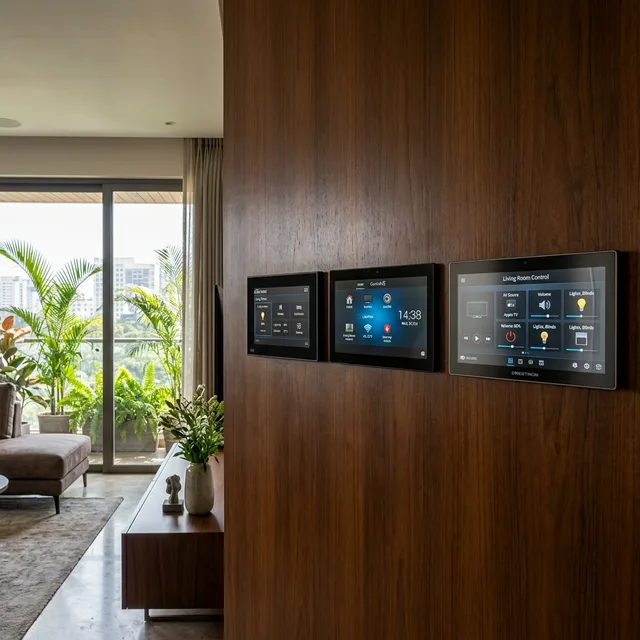
- Architectural touchscreens and keypads: Crestron Horizon keypads and TSW touchscreens offer refined metal finishes, tactile feedback, and bespoke engraving that complement luxury interior architecture.
- Integration versatility: Integrates with virtually any protocol, including BACnet, Modbus, KNX, DMX, and corporate network infrastructures.
Practical limitations
- Significant capital investment: Hardware and programming costs sit substantially above mid-market alternatives.
- Specialized programming expertise: Advanced custom systems require certified Crestron programmers. Maintenance and future upgrades depend on qualified technical specialists.
- Excessive for compact layouts: For standard 3 or 4BHK apartments, Crestron hardware capacity and complexity exceed practical residential requirements.
Recommended applications
Ultra-luxury estates, multi-structure compounds, residences requiring extensive AV-over-IP video distribution, and properties where unified control must match commercial building management standards.
Platform comparison overview
| Factor | KNX | Control4 | Crestron | ||||
| Standard type | Open international standard | Proprietary platform | Proprietary platform | ||||
| System architecture | Decentralized bus intelligence | Centralized controller | Centralized processor | ||||
| Vendor independence | High (500+ manufacturers) | Moderate (Snap One ecosystem) | Moderate to high (extensive protocol support) | ||||
| Media and entertainment | Requires gateway or hybrid layer | Native core strength | High-performance custom integration | ||||
| Best construction stage | New construction / bare shell | New construction or retrofit | New construction / deep renovation | ||||
| Local operation without internet | Complete local functionality | Complete local functionality | Complete local functionality |
The hybrid approach: combining the best of both
In many luxury residences in Bengaluru, the most effective solution is not choosing between KNX and Control4 or Crestron, but combining them into a hybrid architecture.
Under a hybrid model:
- KNX handles the building backbone: All lighting circuits, DALI drivers, HVAC actuators, and motorized shading run on the decentralized KNX bus. This architecture isolates core electrical and mechanical infrastructure from multimedia software updates, helping maintain basic switching and climate control even as consumer entertainment hardware evolves over time.
- Control4 or Crestron provides the user experience: A centralized controller interfaces with the KNX bus to manage multi-room music, home theatre equipment, intercoms, and mobile app interfaces.
This division of responsibility protects your physical building investment while delivering a polished daily interface for entertainment.
Planning a new residential build in Bengaluru? Discuss your automation architecture with our engineering team to review system schematics and platform options.
Frequently asked questions
Can existing electrical switch plates be upgraded to KNX?
KNX keypads connect to low-voltage bus wiring rather than high-voltage line current. Upgrading an existing home to KNX requires routing a bus cable to each keypad location or using wireless KNX RF modules where conduit space allows. During an initial site review, engineers inspect existing conduits to determine whether bus pulling is feasible.
Does Control4 require internet connectivity to operate daily functions?
No. Daily automation within the home operates over the local area network. In-wall keypads, handheld remotes, and local app controls continue working during broadband outages. An internet connection is only required for remote access outside the home, streaming audio content, and automated weather feeds.