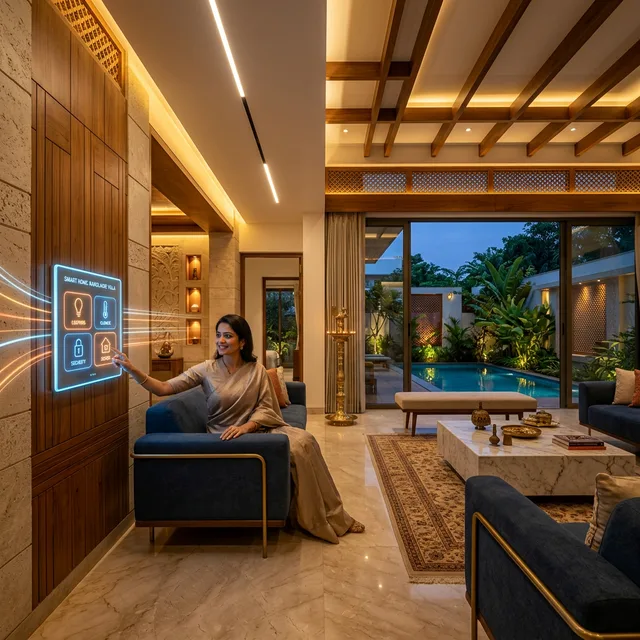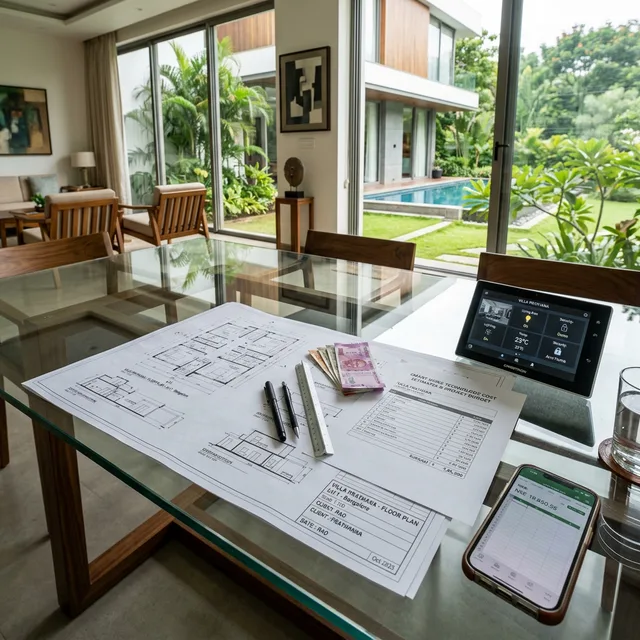
One of the first questions homeowners and architects ask is what home automation actually costs in Bengaluru. The realistic answer is that pricing depends on property scale, subsystem scope, wiring infrastructure, and platform choice.
Rather than relying on vague estimates, this guide breaks down the primary cost drivers, indicative budget ranges, and long-term operating expenses based on residential projects across South India. To evaluate system architectures, review our residential home automation systems in Bengaluru.
Hypothetical budgeting illustrations
Every residence has unique architectural and engineering requirements. To help prospective buyers plan before commissioning site surveys, the following tiers represent hypothetical budgeting illustrations based on typical residential configurations, rather than fixed quotations or observed market averages:
- Essential automation illustration (lighting and basic security): ₹2 to 5 lakh. Typically covers automated lighting circuits in living and dining zones, smart video door phones, and basic security sensors in a 2 or 3BHK apartment.
- Comprehensive automation illustration (3 to 4BHK residence): ₹8 to 18 lakh. Covers centralized lighting across all primary rooms, multi-zone climate scheduling, motorized curtains in key areas, and integrated access control.
- Turnkey villa automation illustration: ₹20 to 50 lakh. Integrates wired bus lighting (such as KNX or Lutron), HVAC integration, motorized shading, multi-room audio, perimeter security, and acoustic coordination for a custom home theatre.
- Architectural luxury estate illustration: ₹50 lakh and above. Custom high-channel processors, complete KNX or Crestron infrastructure, architectural keypads, dedicated private cinema integration, and redundant network hardware.
Actual pricing depends on engineering drawings, circuit schedules, and brand selections. A site-specific survey and quotation are necessary for any project.
Primary factors that determine project cost
Understanding what drives expenditure allows you to prioritize features that deliver the most daily utility.
Property scale and construction phase
Property size influences the number of control modules, power supplies, and cabling runs required. However, the construction stage matters just as much as square footage:
- New construction or bare-shell interiors: Laying conduit before plastering allows centralized DIN-rail automation panels and low-voltage bus cabling. This is the cleanest and most cost-effective method per controlled point.
- Retrofit installations in completed homes: Automating an existing home without chasing conduits requires wireless modules behind existing switch plates or hybrid communication protocols. While it avoids civil alterations, wireless hardware per point can carry a premium, and signal range must be planned carefully around thick masonry walls.
Platform and protocol architecture
Different automation platforms cater to different project priorities:
- Open bus standards (KNX): Devices communicate over a dedicated two-wire bus independent of any single manufacturer. Keypads, dimmers, and relays from brands like Schneider, ABB, Jung, and Zennio can operate on the same system. Hardware costs reflect industrial-grade reliability and modular scalability.
- Proprietary ecosystems (Control4, Crestron): These platforms combine processing hardware with unified software interfaces. They excel at managing complex media distribution, surround sound processors, and whole-home entertainment alongside lighting and climate.
- Smart switch modules (Legrand, Schneider): Suitable for localized lighting control where centralized panel infrastructure is not feasible.
Subsystem scope
Cost scales with the number of systems connected to the central controller:
- Architectural lighting control: Varies based on whether circuits require simple on/off switching, phase-cut dimming, 0-10V control, or digital DALI-2 drivers for tunable white illumination.
- Climate integration: Interfacing with VRV or VRF air conditioning systems requires dedicated BACnet, Modbus, or manufacturer-specific communication gateways.
- Motorized window treatments: Motors, power wiring, and custom motorized tracks for drapery and roller shades vary with window dimensions and fabric weights.
- Multi-room distributed audio: In-ceiling architectural speakers, streaming amplifiers, and audio matrix switches sized by zone count.
- Security and access control: IP surveillance cameras, network video recorders, smart door locks, and intrusion alarm sensors.
Professional engineering and commissioning
Hardware represents only part of an automation budget. System reliability depends on engineering design, panel assembly, structured cabling documentation, scene programming, and multi-stage testing during handover. Engineering and commissioning fees reflect the required design drawings, panel building, and programming depth rather than a fixed markup.
Illustrative project planning scenarios
These hypothetical scenarios illustrate how budgets may be structured across different property scales. They are conceptual planning models rather than historical client invoices or fixed turnkey packages.
Scenario 1: Hypothetical 3BHK apartment interior upgrade (illustrative ₹7.5 lakh)
- Centralized lighting control for living, dining, and master suite (16 dimmable channels)
- Motorized curtain tracks in living room and master bedroom
- Smart video door phone with electronic lock integration
- App-based scene control with wall keypads in primary zones
- Panel assembly, cable termination, and system commissioning
Scenario 2: Hypothetical 4BHK independent villa (illustrative ₹26 lakh)
- Decentralized KNX bus infrastructure for whole-home lighting (42 circuits)
- DALI-2 broadcast control for architectural downlights and cove accents
- VRV air conditioning integration across four bedroom suites and family lounge
- Dedicated 5.1.2 Dolby Atmos media room integration with acoustic wall panels
- Eight exterior IP surveillance cameras with network video storage
- On-site project management, CAD line drawings, and comprehensive handover
Scenario 3: Hypothetical large luxury residence (illustrative ₹65 lakh)
- Full-home automation combining KNX lighting and Crestron media orchestration
- Motorized architectural shading across all floor-to-ceiling facades
- High-resolution multi-room audio across eight indoor and outdoor zones
- Dedicated private cinema room with 7.2.4 immersive audio and 4K laser projection
- Perimeter virtual boundary detection, biometric entry gates, and isolated security VLAN
- Dedicated equipment rack with thermal management and power conditioning
Operating costs and maintenance considerations
Prospective buyers should budget for long-term ownership factors:
- Remote access software: Certain proprietary platforms require annual software subscriptions for remote connection outside the local Wi-Fi network.
- Network infrastructure: Reliable automation requires commercial-grade routers, managed network switches, and Wi-Fi access points to handle high device counts without dropping packets.
- Annual maintenance agreements: Complex systems benefit from periodic preventive checkups, firmware updates, and sensor recalibration.
Energy management realities
Smart automation helps manage electricity consumption by eliminating unintended waste. Key mechanisms include:
- Automated climate setbacks: Adjusting setpoints when rooms are unoccupied prevents air conditioning units from running continuously in empty guest rooms.
- Scheduled lighting scenes: Automatically turning off outdoor pathway lighting at dawn and dimming ambient spaces late at night.
- Daylight harvesting: Sensors near large windows lower artificial light output when ambient daylight is sufficient.
Actual utility bill reductions depend heavily on baseline household habits, room occupancy schedules, and building insulation. Claims of guaranteed 30% to 40% bill savings are rarely verifiable across diverse residential properties.
Ready to plan your installation? Discuss your home automation project with our engineering team to review floor plans and develop an accurate load schedule.
Frequently asked questions
Is smart home automation suitable for an existing apartment in Bengaluru?
Yes. While new construction provides the flexibility to run low-voltage bus wiring before walls are plastered, existing apartments can be automated using retrofit-friendly wireless or hybrid modules. During a site survey, our engineers inspect existing electrical backboxes and conduit depth to identify the cleanest implementation path.
Can an automation system be installed in phases?
Yes. Open standards like KNX and scalable platforms like Control4 allow phased implementation. Many clients automate lighting and security infrastructure during the initial interior fit-out, adding distributed audio, motorized window treatments, and media room integrations in later phases without replacing core controllers.