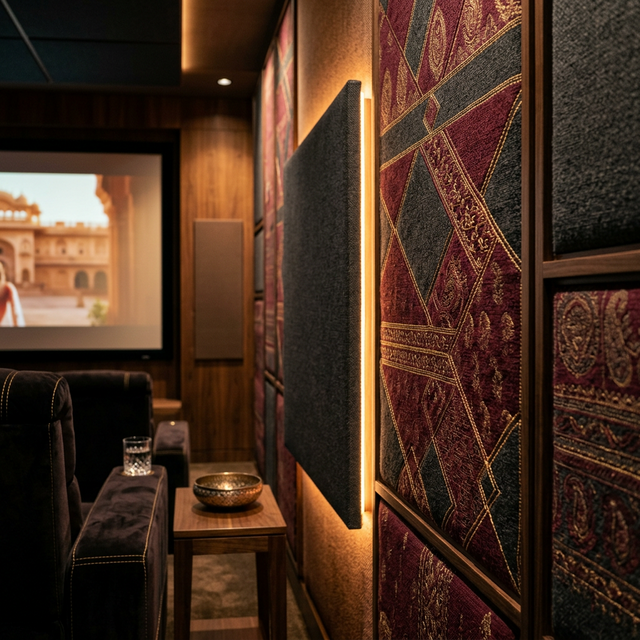
You can spend ₹50 lakh on the world's finest speakers and AV processor, but if your room has untreated parallel walls, yours will sound like a bathroom. Acoustic treatment is the single highest-impact, most cost-effective investment in any home theatre — yet it is consistently the most overlooked. This guide explains what acoustic treatment is, how it works, and how Synchronos Solutions implements it in home theatres across Bangalore.
Why Acoustics Matter More Than Your Equipment
Sound doesn't simply travel from a speaker to your ear. It bounces off every surface in the room — walls, floor, ceiling — and arrives at your ears from multiple directions and at different times. These reflections create:
- Flutter echo: A rapid succession of echoes between parallel walls creating a "metallic" colouration of sound.
- Standing waves (room modes): Bass frequencies that reinforce or cancel at specific positions, creating seats where bass is overwhelming and others where it nearly disappears.
- Early reflections: The first bounce off side walls or ceiling that arrives 5–30ms after the direct wave — smearing stereo imaging and reducing clarity.
- High reverb time: Reverberations that linger and blur subsequent sounds, reducing intelligibility.
The Three Pillars of Home Theatre Acoustics
1. Soundproofing (Sound Isolation)
Soundproofing stops sound from crossing a construction boundary — keeping outside noise out and your cinema's sound in. It is governed by the principle of mass, decoupling, and absorption in the cavity.
<h4>Mass:</h4>Heavy, dense materials transmit less sound energy. Double-leaf walls (two separate layers of brick or concrete) with an air gap are the architectural gold standard. For apartments, Synchronos uses mass-loaded vinyl (MLV) laminates bonded to existing walls — adding surface density without significant construction work.
<h4>Decoupling:</h4>Physical disconnection between inner and outer shells prevents vibration transmission. Solutions include resilient channel mounts for plasterboard layers and rubber anti-vibration pads under floating floor systems.
<h4>Floor Isolation:</h4>Bass frequencies transmit extremely well through concrete slabs — particularly relevant in Bangalore's multi-story apartments. A floating floor assembly (rubber neoprene isolation pads + secondary structural layer) is essential for bass-heavy home theatres.
2. Absorption
Absorption panels convert sound energy into heat through friction in porous material. They reduce the reverb time of the room and eliminate flutter echo.
<h4>Broadband Absorbers:</h4>Mineral wool or compressed fibreglass panels (50–100mm thick) mounted at all first-reflection points: side walls at the speaker-to-ear reflection point, rear wall, and ceiling cloud above seating. A 50mm panel of 60 kg/m³ mineral wool provides excellent absorption above 500Hz.
<h4>Bass Traps:</h4>Corner-mounted, floor-to-ceiling porous absorbers targeting low frequencies. Corners are where standing waves achieve maximum pressure — placing absorbers here addresses the most problematic bass buildup. Synchronos typically specifies 100–200mm thick panels in all four vertical corners.
3. Diffusion
Diffusion scatters sound in multiple directions, reducing discrete reflections while preserving a sense of spaciousness. Too much absorption creates a dead, uncomfortable room. Diffusion maintains liveliness.
QRD (Quadratic Residue Diffusers) and Skyline diffusers are designed using number theory to scatter across a wide frequency range. Synchronos uses custom-designed diffusers (often finished in wood or acoustic fabric to match interior aesthetics) on rear walls and ceiling at the listening position.
Target Room Acoustics for Home Theatre
- RT60 (reverberation time): 0.2–0.4 seconds across 200Hz–5kHz. This is like a professional recording studio — tight and controlled.
- Frequency response variation at listening position: ±3dB from 80Hz–16kHz (achievable with professional calibration post-treatment).
- Background noise (NC rating): NC-25 or below. This is quieter than a library and is essential for hearing the quietest details in film soundtracks.
Measuring and Calibrating Room Acoustics
Before and after acoustic treatment, Synchronos uses Room Equalization Wizard (REW) software with a calibrated measurement microphone (Dayton Audio OmniMic or miniDSP UMIK-1) to:
- Map RT60 at octave bands from 63Hz to 8kHz
- Identify standing wave modes (waterfall plots)
- Measure early reflection arrival times
- Generate correction curves for the AV processor's room EQ (Audyssey MultEQ XT32, Dirac Live, or Anthem ARC Genesis)
Acoustic Design Aesthetics — Making it Beautiful
A common misconception: acoustic panels are ugly industrial foam. In Synchronos's projects, acoustic elements are integral to the interior design:
- Fabric-wrapped absorption panels in custom colours matching the theatre's palette
- Wood slat diffusers that double as architectural feature walls
- Perforated leather or velvet covering on wall panels
- Illuminated soffit panels with integrated acoustic absorption
FAQ
Is acoustic treatment different from soundproofing?
Yes, completely. Soundproofing stops sound from crossing walls. Acoustic treatment controls sound behaviour inside the room. Both are needed for a proper home theatre. Most DIY mistakes treat only one and wonder why results are poor.
Can acoustic treatment be added to an existing room?
Yes. Synchronos has successfully treated existing rooms in Bangalore, Chennai, and Hyderabad without significant construction work, using strategic panel placement and floating floor mats. Results won't match a purpose-built room, but improvements are dramatic.
How much does acoustic treatment cost in Bangalore?
For a 200–300 sq ft dedicated home theatre room: ₹2–5 lakh for comprehensive acoustic treatment (soundproofing + internal treatment). This is separate from the AV equipment cost and is among the best investments in the project.

