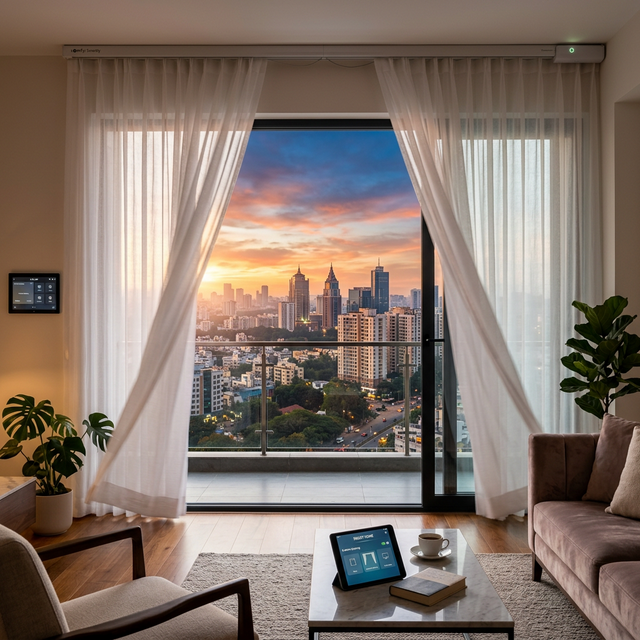
Two industries intersect in every modern home: interior design, which shapes how a space looks and feels, and smart home technology, which determines how it functions and behaves. For most of the past two decades in India, these industries operated separately — and the results of that separation were predictable. Beautiful interiors with technology bolted on afterwards, in compromised positions, with ugly surface conduits and switch plates that broke the design intent. Or technically impressive smart systems installed in aesthetically disappointing rooms that no one actually enjoyed living in.
Synchronos Solutions was founded on a specific conviction: that this separation is unnecessary, damaging to both outcomes, and fixable — by one company mastering both disciplines simultaneously.
When Technology Ignores Design
Consider the common scenario: a homeowner hires an interior designer who creates a beautiful concept for the living room — careful paint colours, bespoke joinery, curated furniture. Then an automation engineer arrives and announces that the main AV console must be positioned at the left side of the alcove (breaking the symmetry), that cable runs must be surface-mounted along the skirting (destroying the plaster finish), and that the touch panel goes on the wall opposite the main window (creating glare). Each decision is justified on technical grounds. The design intent is systematically destroyed.
When Design Ignores Technology
Equally common: an interior designer creates a magnificent plan — induction chef's kitchen with recessed lighting, master bedroom with architectural joinery, living room with a floating media wall. The electrician then reveals that no conduit was planned for the motorised blind motors, the automation wiring wasn't integrated into the underfloor run, and there's no space for the AV rack behind what's become solid joinery. The retrofit is expensive, invasive, and always visible.
The Design-Technology Fusion: How It Actually Works
At Synchronos, integrated projects begin differently. Interior design and technology design happen simultaneously, by the same team, with constant cross-pollination:
Phase 1: Unified Brief
The initial client consultation captures both lifestyle aspirations (the design intent) and technology requirements (the functional intent). These are not treated as separate conversations — they are the same conversation. How do you want to feel when you walk in the door? What's the first thing you do in the morning? How do you entertain? These answers inform both the colour palette and the automation scenes.
Phase 2: Coordinated Schematic Design
The interior schematic and the automation/AV topology are developed together:
- Touch panel positions are specified simultaneously for electrical accessibility and for visual balance within the room
- Speaker locations are optimised for acoustics without compromising the joinery design
- Cable runs are designed into the structural slab before pouring, not chased afterwards
- Lighting positions are specified for both HCL requirements and architectural impact
Phase 3: Material and Equipment Selection
In a fused design process, the aesthetic of equipment is as important as its specification:
- Lutron's Palladiom touch panels, finished in Warm Pewter or Warm Silver, are selected to match the kitchen hardware finish
- In-wall speaker grilles are flush-mounted and custom-painted to match wall colour
- Camera housings are colour-matched to exterior wall treatments
- CCTV cameras use dome form factors that disappear against ceilings rather than barrel cameras that protrude obtrusively
Case Studies in Integration
The Transparent Living Room
A Koramangala client wanted a living room that felt technology-free — no visible screens, no visible speakers, no visible panels. Synchronos designed a floating white lacquer joinery wall concealing a 77" Samsung Frame TV (which displays artwork when unused), in-wall Krix speakers with flush grilles painted white, a hidden integrated AV rack behind a full-height panel, and a single Lutron keypad in champage silver — the only visible technology in the room. The system is fully automated; the room appears entirely technology-free.
The Heritage Bungalow Preservation
A Basavanagudi heritage villa required smart automation without visible conduit, without touching original teak joinery, and without changing switch plate positions. KNX RF wireless technology, micro-module retrofits behind existing switch plates, and wireless sensor installation allowed complete home automation without a single visible cable or structural modification.
The Hettich and Hafele Partnership Advantage
Synchronos's partnerships with Hettich, Hafele, Blum, Saint-Gobain, and other premium hardware companies extends the design integration further: motorised hardware, soft-close mechanisms, and modular furniture systems that integrate seamlessly with automation. A kitchen island with built-in smart lighting, integrated wireless charging, and an automated lift mechanism for heavy appliances — all from a single design and supply partner.
FAQ
Which discipline should lead — interior design or technology?
Neither should "lead" — they must coevolve simultaneously. In practice, interior design typically sets the aesthetic framework and technology integration optimises within it, occasionally pushing back when technical requirements are non-negotiable (certain speaker positions are scientifically determined and cannot be compromised).
Can Synchronos handle just the interiors, without automation?
Yes. Synchronos executes complete interior-only projects for clients who do not require automation. However, we always recommend planning conduit infrastructure for potential future automation — a negligible cost during construction that saves enormous expense in a retrofit.