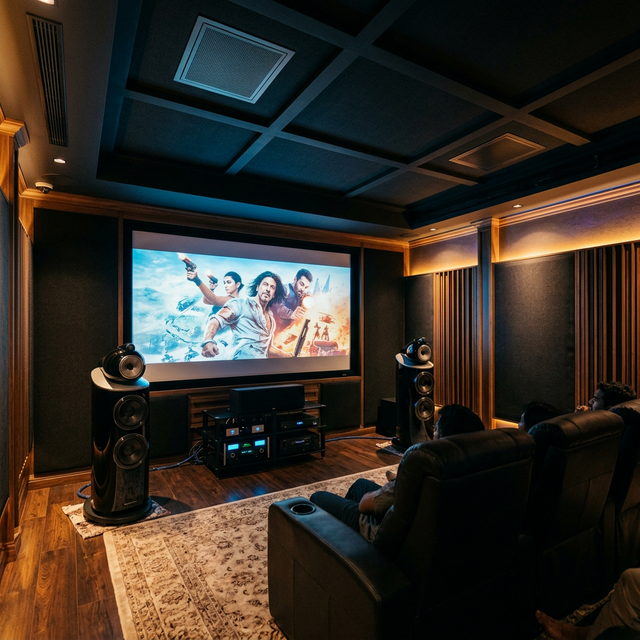
The battle for immersive audio supremacy in home cinema is real, and the two most significant competitors — Dolby Atmos and Auro 3D — take fundamentally different approaches to the same goal: placing you inside the movie's soundfield rather than simply surrounding you with it. This guide, informed by Synchronos Solutions' extensive home theatre installation experience across South India, provides a clear, practical comparison.
The Core Difference: Object vs. Channel
Dolby Atmos: Object-Based Audio
Dolby Atmos represents a philosophical departure from traditional surround sound. Instead of assigning sounds to fixed speaker channels (Left, Right, Centre, Surround Left, etc.), Atmos treats sounds as audio objects — each with position metadata that specifies where in a 3D sphere it should be rendered. The decoder in your AV processor maps these objects to whatever speaker configuration is available — whether it's a 5.1.2 system or a 9.1.6 Atmos installation. A helicopter assigned to a specific overhead position will be rendered as accurately as your speaker count allows.
Auro 3D: Channel-Based 3D Audio
Auro 3D, developed by Belgian company Auro Technologies, layers additional speaker channels in a "first-floor" (ear level) and "second-floor" (45° elevation) arrangement, topped by a ceiling speaker called the "Voice of God" channel. Unlike Atmos's object positioning, Auro 3D uses a fixed channel architecture:
- Auro 9.1: 5.1 base layer + 4 height channels + Voice of God
- Auro 11.1: 7.1 base layer + 4 height + Voice of God
- Auro 13.1: 7.1 + High layer + Voice of God
Auro 3D is primarily accessible via DTS:X Master Audio or dedicated Auro-encoded releases (Blu-ray discs with Auro codec).
Speaker Placement: The Critical Difference
Dolby Atmos Speaker Placement
Dolby specifies height speakers at two elevation angles from the main listening position:
- Front height: 30° elevation, aligned with front L/R
- Rear height: 55° elevation, between surround and rear
This is achievable via in-ceiling speakers (preferred) or Dolby Atmos-enabled modules (upfiring speakers) — compromise solutions that work acceptably but don't match dedicated ceiling speakers.
Auro 3D Speaker Placement
Auro 3D height speakers are at 45° elevation — one specific angle for all height channels. The Voice of God speaker is directly overhead at 90°. Auro's fixed angles mean that if your room dimensions place seated listeners in positions where 45° creates awkward geometry, the height channel impacts are less optimal.
Content Availability
Auro 3D's most significant commercial limitation is content availability:
- Dolby Atmos: Supported by virtually every major Hollywood studio, Netflix, Disney+, Apple TV+, Amazon Prime Video. In 2026, the majority of premium streaming content is available in Atmos. Indigenous Indian productions on Netflix and Amazon are increasingly being produced in Atmos.
- Auro 3D: Content is limited to specific licensed Blu-rays and specialty releases. Streaming support is minimal. The content ecosystem is significantly smaller.
DTS:X: The Third Contender
Worth including in any objective comparison: DTS:X is DTS's object-based 3D audio format, similar in architecture to Atmos. DTS:X Masters use the same speaker layouts as Atmos and are supported by the same AV processors. Content availability is slightly below Atmos but improving rapidly. Most modern AV processors that decode Atmos also decode DTS:X — for practical purposes, DTS:X can be considered a close Atmos alternative rather than a separate decision.
Hardware Requirements Comparison
<table> <thead><tr><th>Parameter</th><th>Dolby Atmos</th><th>Auro 3D</th></tr></thead> <tbody> <tr><td>Minimum speaker config</td><td>5.1.2</td><td>9.1 (8 + sub)</td></tr> <tr><td>Recommended config</td><td>7.1.4</td><td>11.1 or 13.1</td></tr> <tr><td>Height speaker angle</td><td>30° + 55°</td><td>45° uniform</td></tr> <tr><td>Voice of God channel</td><td>No</td><td>Yes (optional)</td></tr> <tr><td>Content ecosystem</td><td>Very large</td><td>Limited</td></tr> <tr><td>Streaming support</td><td>Excellent</td><td>Minimal</td></tr> <tr><td>Processor support</td><td>Universal</td><td>Licensed (Datasat, Trinnov, Anthem)</td></tr> </tbody> </table>The Synchronos Recommendation
For the vast majority of Synchronos home theatre clients, Dolby Atmos is the correct choice in 2026:
- Superior content availability — the largest library and the direction all major studios and streaming services are moving
- Hardware flexibility — works with any premium AV processor
- Excellent immersion in a well-configured 7.1.4 setup with proper acoustic treatment
Auro 3D is a compelling choice only for dedicated cinephiles who specifically value the Auro philosophy and have access to Auro-encoded reference recordings, and whose budget extends to processors running Trinnov or Datasat platforms. In these cases, running both Atmos and Auro 3D decoding capability (which some premium processors support) provides the best of both worlds.
FAQ
Can one speaker system play both Dolby Atmos and Auro 3D?
Yes — if the room has height speakers at the correct elevations for both formats. Auro 3D's 45° and Atmos's 30°/55° are different, but many installations find a compromise elevation that performs adequately for both. Processors like the Trinnov Altitude support both natively.
Is Dolby Atmos available for streaming in India?
Yes — Netflix, Apple TV+, and Amazon Prime Video all offer Dolby Atmos content in India on qualifying plans. Titles are identified by the Atmos badge in the app. A streaming device (Apple TV 4K, Nvidia Shield, Fire TV Cube) and an Atmos-capable AV processor are required.

