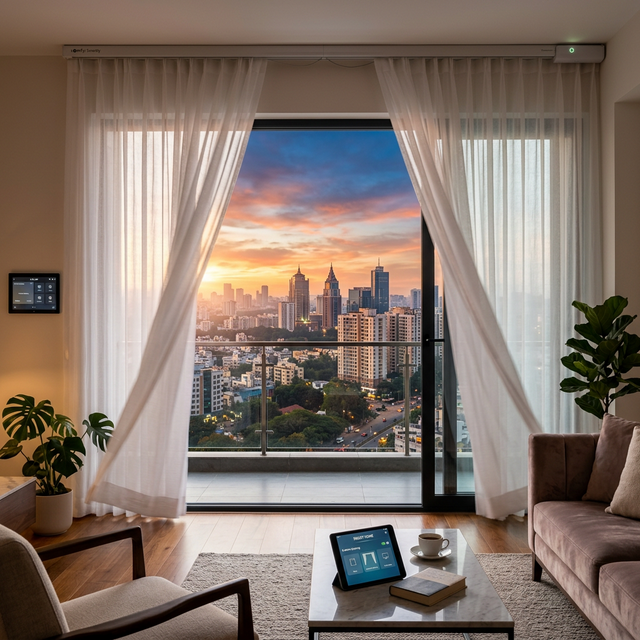
Of all the smart home elements that surprise clients most after installation, motorised window treatments consistently rank first. The convenience of waking up to curtains that automatically open at sunrise, or a "Movie Night" scene that simultaneously closes all blinds, dims the lights, and activates the projector — these experiences transform how you interact with your home. Yet automated window treatments are among the most overlooked components when planning a smart home in Bangalore.
Why Motorised Blinds Are More Than a Luxury
Motorised window treatments serve multiple functional roles beyond convenience:
Solar Heat Gain Control
Bangalore's intense summer sun (April–June, with temperatures reaching 38°C+) creates significant solar heat gain through south and west-facing windows — often the largest contributor to afternoon air conditioning load. Automatic solar blinds that deploy at 11 AM when the sun angle reaches a threshold can reduce AC energy consumption by 15–25% in west-facing rooms.
Privacy Automation
Context-sensitive privacy: blinds close automatically at sunset, when the security system is disarmed (indicating you're home at night), or when a video call is detected on your laptop. No manual operation required.
Home Theatre Integration
A dedicated home cinema room requires complete light control. Motorised blackout blinds that close as part of a "Movie" scene — seamlessly, automatically, without requiring physical access to the window — are essential for south-facing or naturally lit cinema rooms.
Human-Centric Lighting Enhancement
Motorised blinds that coordinate with HCL systems modulate natural daylight throughout the day: fully open in the morning for maximum daylight, partially closed at noon for glare control, re-opening in the afternoon for warm late sun, and closed at sunset as warm artificial light takes over.
Motorisation Technologies
Lutron Sivoia QS
Lutron's premium motorised shading system is the gold standard for integrated smart home deployments. The Sivoia QS range covers:
- Roller shades (fabric, blackout, screen, natural)
- Roman shades and drapery tracks
- Venetian blinds and horizontal louvres
- Skylight blinds
Sivoia QS communicates via Lutron's proprietary Clear Connect RF protocol (dedicated spectrum, no interference with Wi-Fi or Zigbee) and integrates natively with Lutron Homeworks, Control4, Crestron, and KNX home automation systems.
Somfy
Somfy is the most widely specified motorised blind brand globally, with an extensive product range covering curtain tracks, roller blinds, Venetian blinds, and outdoor awnings. Somfy's TaHoma connectivity platform integrates with Apple HomeKit, Google Home, and professional automation systems via RS-485 or RTS protocol adapters.
Dooya and Zemismart
Chinese-manufactured curtain track motors with Zigbee or Wi-Fi connectivity — excellent value for retrofit projects where precision Lutron engineering is not required. Integrated with Home Assistant, SmartThings, or Control4 via Zigbee bridge.
Fabric Selection: The Design Element
The fabric is the element most visible in your home every day. Key considerations for Bangalore:
- Solar shading factor (OF): How much solar heat the fabric blocks. For west-facing rooms, OF 5–6% maximum for blackout, OF 1–3% for solar screen fabrics that maintain outside view while blocking heat.
- Natural fibres vs. technical fabrics: Belgian linen and silk are beautiful but incompatible with motorisation (weight, dimensional stability). Technical polyester fabrics maintain precise dimensions for reliable mechanical operation in India's humidity variations.
- Blackout vs. dim-out vs. screen: Blackout for bedrooms and cinema rooms. Dim-out (95% light reduction) for children's rooms. Screen fabric for living areas — blocks heat and glare while maintaining daytime outside view.
Installation in Bangalore Homes
Motorised blinds require consideration for Bangalore's specific context:
- Power supply: 240V AC motors are standard. Battery-powered motors (Somfy Sonesse) eliminate hardwiring but require annual charging. We recommend hardwired installations where possible for reliability.
- Humidity: Bengaluru's monsoon (June–September) creates high humidity. Specify products with corrosion-resistant hardware and moisture-stable fabrics, particularly for open-plan rooms adjacent to balconies.
- Dust: Bangalore's construction-zone context means exterior-mounted automated screens must be specified for IP54 or higher dust/rain protection.
Cost of Motorised Blinds in Bangalore
- Entry-level (Dooya/Zemismart with Wi-Fi): ₹8,000–15,000 per window including fabric and installation
- Mid-range (Somfy with smart hub integration): ₹18,000–35,000 per window
- Premium (Lutron Sivoia QS with full Control4 integration): ₹35,000–80,000 per window depending on size and fabric
FAQ
Can motorised blinds be added to existing curtain tracks?
Yes, for most standard curtain tracks (straight, no curved sections). Somfy and Dooya motors can retrofit to existing tracks. Blind systems require their own track or roller mechanism.
How is the power supplied to motorised blinds in new construction?
A 240V AC supply point with earth is provisioned at or within the fascia / cornice during construction — planned as part of the electrical design. For retrofit, surface conduit or concealed chase is used.

