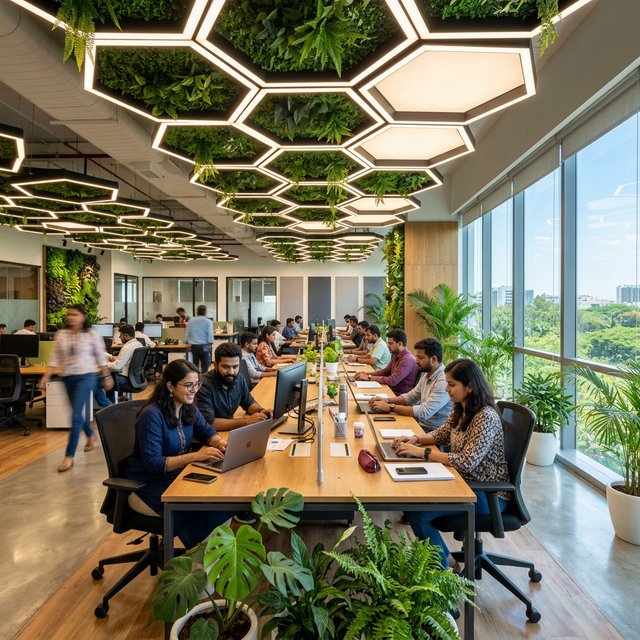
Walk into most Bangalore tech offices and you'll find the same ceiling: a grid of 4000K cool white LED panels, operated by a single wall switch, running at maximum brightness from 9 AM to 7 PM. It's functional. It's also contributing to eye strain, afternoon fatigue, disrupted sleep patterns, and diminished cognitive performance — all of which directly cost your business productivity and healthcare costs. Smart DALI lighting systems with Human-Centric Lighting (HCL) profiles can change this — and the ROI is well documented.
The Problem with Static Office Lighting
Human biology requires dynamic light — our circadian rhythms evolved over millions of years in environments where light intensity, colour temperature, and spectral composition changed continuously throughout the day. A fixed 4000K, 400-lux fluorescent ceiling produces:
- Afternoon circadian dysregulation: The same light that helps alertness at 9 AM disrupts melatonin synthesis at 4 PM, creating the "2 PM slump" — a biological consequence of inappropriate lighting, not laziness.
- Eye strain and headaches: Excessive blue-rich light at constant brightness creates visual fatigue over 8-hour exposures. Studies from TNO (Netherlands) show 35% of office workers report chronic eye strain attributable to lighting.
- Inconsistent task surface illumination: Standard grid lighting creates shadows on desks, causing unconscious facial muscle tension as workers lean or strain to read documents.
DALI Smart Lighting: The Professional Foundation
DALI (Digital Addressable Lighting Interface) is the professional lighting control protocol used in every high-quality commercial smart lighting installation. Unlike simple dimmer switches, DALI:
- Addresses each individual luminaire or group independently (up to 64 devices per DALI line)
- Provides 256 discrete dimming levels (vs. 7–10 levels on conventional dimmers)
- Supports two-way communication — the controller knows the actual state of every fixture
- Integrates with occupancy sensors, daylight sensors, and BMS platforms via standard interfaces
- Supports DALI-2 extended features: emergency lighting, device identification, event-driven control
DALI is the control backbone. What you control with it determines the experience.
Human-Centric Lighting Profiles for Office Spaces
An HCL-programmed DALI system follows a biological light recipe across the workday:
Morning Activation (8:00–10:00 AM)
5000–6500K, 400–500 lux at the desk. Bright, blue-enriched light that suppresses residual sleep inertia and promotes cortisol production. Sets teams up for cognitively demanding morning tasks.
Focus Peak (10:00 AM–1:00 PM)
4000–4500K, 300–400 lux. Neutral white matching outdoor sky conditions on a bright overcast day. Sustains attention and reduces eye adaptation fatigue.
Post-Lunch Recovery (1:00–3:00 PM)
Option 1: Brief "vitalization" mode — a 30-minute pulse of 5500K, 500+ lux — has been shown in European studies to counter post-lunch dip more effectively than caffeine. Option 2: Gradually warmer settings to support quiet focus work.
Evening Wind-Down (5:00 PM–close)
3000–3500K, 200 lux. Warmer, dimmer light begins melatonin production, reducing the evening disruption to sleep patterns from working late.
Daylight Harvesting: The Energy Bridge
For Bangalore offices with south-facing windows (ECil, Whitefield, Manyata), daylight harvesting provides massive energy savings. DALI-connected photosensors measure available daylight and continuously adjust artificial light levels to maintain a constant 400 lux on desks — regardless of cloud cover or time of day. When full sun illuminates a south-facing open plan, artificial lighting dims to zero. When clouds pass, it compensates automatically. Synchronos data from implemented projects shows 25–40% energy saving in perimeter zones alone.
Occupancy Control in Open-Plan Offices
Open-plan offices in Bangalore tech companies are rarely fully occupied — remote work, travel, and meetings mean any zone is unused 40–60% of the day. DALI occupancy sensors (PIR + microwave dual-technology) dim lighting to 10% after 8 minutes of vacancy and switch off after 15 minutes. Result: 20–35% additional energy savings on top of daylight harvesting.
The Business Case
- Energy savings: 30–50% vs. conventional non-dimmed LED grid (documented in Synchronos Electronic City deployments)
- Productivity improvement: 12–23% improvement in knowledge worker task performance under properly designed HCL (European Commission WELL certification research)
- WELL Certification: HCL is a mandatory component of WELL Building Standard certification — increasingly required by premium tenants in Bangalore's Grade A office market
- Investment payback: Typically 3–5 years from energy savings alone, faster when WELL rental premium is factored in
FAQ
Can existing office lighting be upgraded to smart DALI without complete rewiring?
Sometimes yes — DALI push-button interfaces can replace existing switches without major rewiring, and DALI-addressable drivers can be fitted into existing LED fixtures. A site survey by Synchronos can determine the retrofit feasibility for specific installations.
What office sizes is smart DALI lighting practical for?
From a single conference room (₹50,000–1 lakh) to a full tech park floor (₹15–40 lakh for 30,000 sq ft). Economies of scale mean larger installations deliver faster payback.

